
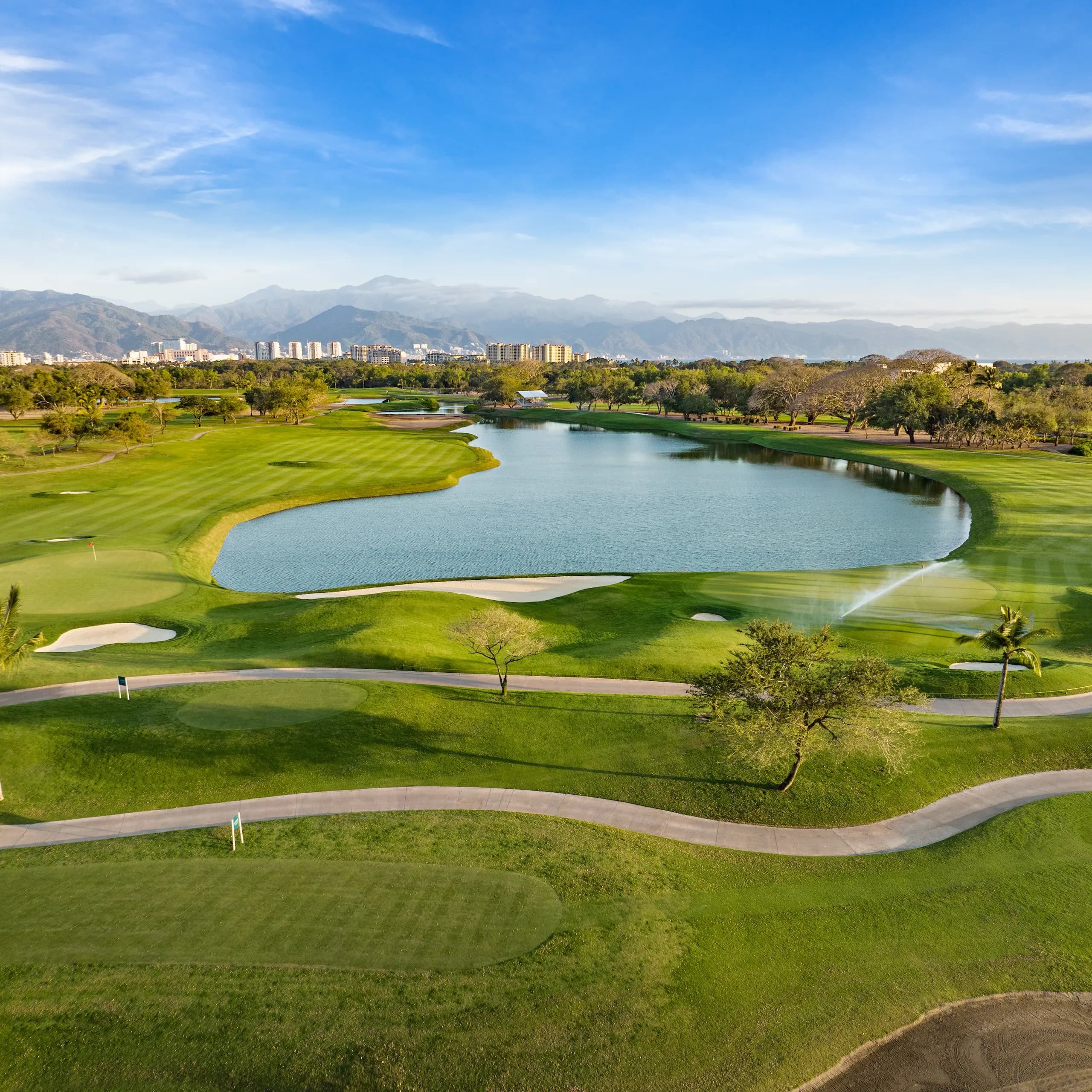
Where the PGA TOUR Meets the Pacific at Vidanta Vallarta
The 2026 VidantaWorld Mexico Open does more than bring professional golf to Nuevo Nayarit. It reveals a broader coastal golf culture stretching from Puerto Vallarta to Punta Mita.
By LUUMHAUS
| Last Reviewed:
Television has a way of compressing a golf destination into a few recognizable images: A player standing over an approach. Water catching the afternoon light. A flag moving beneath a line of mountains. For four days, the broadcast turns an unfamiliar landscape into a place viewers begin to recognize hole by hole.
At Vidanta Vallarta, those images are shaped by the Ameca River, the Sierra Madre, broad paspalum fairways, deep bunkers, and a coastal light that changes throughout the round. But the most important thing the VidantaWorld Mexico Open reveals is not the golf course alone.
It reveals the density around it.
The tournament takes place inside a region where Greg Norman, Jack Nicklaus, Tom Weiskopf, Joe Finger, and other established designers have left markedly different interpretations of Pacific golf. Within the same coastal corridor, players can move from a PGA TOUR venue beside a river to elevated jungle golf, ocean-facing fairways, an island green reached across open water, and a short course designed for an unhurried late-afternoon round.
The tournament may be the most visible expression of golf in Riviera Nayarit and Puerto Vallarta. It is not the beginning of the story.
A National Open with a Longer Memory
The 2026 tournament will be staged under the name VidantaWorld Mexico Open, with the full event week running from October 26 to November 1 and competitive rounds scheduled from October 29 through November 1. It will be the fifth consecutive edition hosted at Vidanta Vallarta since the event joined the PGA TOUR calendar in 2022. For 2026, VidantaWorld also assumes the combined role of title sponsor, host venue, and operator.
The modern presentation, however, sits on top of a much older tournament lineage.
The Mexico Open traces its formal history to the Abierto Mexicano de Golf first contested at Club de Golf Chapultepec in 1944. The PGA TOUR describes it as Mexico's national championship, a distinction that gives the event a different institutional weight from a recently created resort tournament. Its arrival on the PGA TOUR schedule in 2022 did not invent the competition; it moved an established national open onto a larger international platform.
That distinction becomes especially relevant in 2026. The tournament is expected to feature 120 players competing for a $6 million purse and 500 FedExCup points, while the event also coincides with the centenary year of the Mexican Golf Federation. The result is a meeting of two timelines: a contemporary destination event and a national golf culture with a century of institutional history behind it.
Recent champions have helped establish the quality of the Vidanta chapter. Jon Rahm won the first PGA TOUR edition at the venue in 2022, followed by Tony Finau in 2023, Jake Knapp in 2024, and Brian Campbell in 2025. Their victories offer more than name recognition. They demonstrate that the course can reward different competitive profiles, from established major-level talent to players securing defining victories in their careers.
For the traveling golfer, that history changes the experience of standing on a tee at Vidanta. The course is not simply somewhere professional golf has visited. It is a place where the identity of Mexico's national open is still being written.
The Course Behind the Broadcast
The Vidanta Vallarta Course was designed by Greg Norman and follows the Ameca River through the expansive VidantaWorld property in Nuevo Nayarit.
The 2026 event materials describe the underlying resort layout as an 18-hole, par-73 course measuring 7,287 yards, with seven lakes, 49 bunkers, and wall-to-wall paspalum. PGA TOUR tournament configurations can modify par, tees, and playing distances, but the essential architectural character remains consistent: visual width from the tee, followed by more exacting demands around large greens and deep defensive bunkers.
That relationship between generosity and consequence is central to the course.
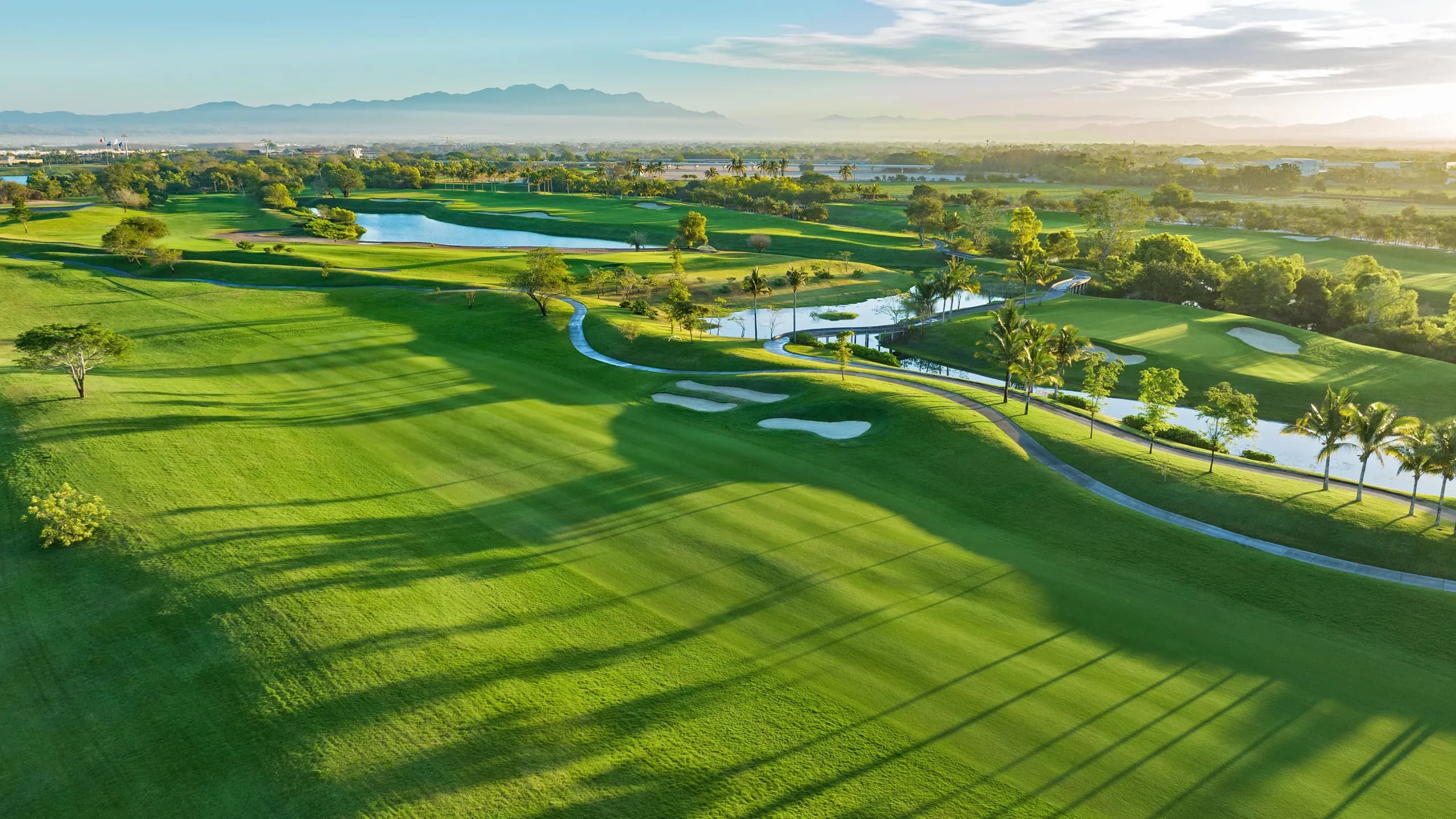
The fairways frequently allow a player to swing with confidence, particularly from the appropriate resort tees. Yet width does not automatically produce an easy score. The approach positions matter. Greens can present movement, runoff, and difficult recovery angles, while the scale of the bunkering makes an imprecise iron shot feel considerably less harmless than it first appeared.
Paspalum also gives the course a distinct playing texture. The grass is well suited to warm coastal environments and generally produces consistent surfaces from tee to green. For visiting golfers accustomed to firmer desert conditions or cool-season turf, the ball may sit and react differently around the greens. The adjustment is subtle but important: distance control and clean contact often matter more than attempting to manufacture excessive spin.
The design also benefits from an unusual separation between the playing corridors and conventional residential development. Native vegetation, water, and the river define much of the visual field, helping the course retain a degree of scale even within a large resort setting. The transition across the Ameca River by the property's long suspension bridge for golf carts reinforces the sense that the round is moving through a larger landscape rather than circulating around a compact hotel course.
The result is an effective tournament venue because it reads clearly on television while remaining understandable to a resort player. The strategic questions are visible. The hazards announce themselves. The course can be approached conservatively, but it continually invites the stronger player to take on a more ambitious line.
It is attractive without allowing the scenery to replace the golf.
More Than a Tournament Course
Vidanta's strongest argument as a golf destination may not be the Norman course itself, but the fact that it functions as the anchor of a broader golf campus.
The property also includes the 18-hole Nayar Course, a more approachable layout with seven lakes and 49 bunkers, and The Lakes Course, a 10-hole par-3 design that can be played under lights until 10 p.m. A golf academy with swing-analysis technology and individual instruction adds a practice component that many resort destinations treat as secondary.
This creates flexibility.
A serious player can reserve the Norman course as the principal round of the trip, use the Nayar Course for a less demanding second day, and play The Lakes after arriving from the airport or returning from an afternoon away from the resort. Families and mixed-ability groups can divide their golf without separating their entire itinerary.
The short course is particularly useful in destination terms. Not every travel day should require five hours, an early alarm, and a complete commitment of energy. Sometimes golf fits better between lunch and dinner, or beneath lights after the temperature begins to fall.
That possibility changes the atmosphere of a golf trip. The game becomes part of the day rather than the day's only purpose.
What "Year-Round Golf" Actually Means
Riviera Nayarit and Puerto Vallarta are frequently described as year-round golf destinations. The statement is broadly correct, but it needs context.
Puerto Vallarta experiences warm conditions throughout the year, while Riviera Nayarit reports an annual average temperature near 25 C, or 77 F. The most temperate period generally extends from late autumn through spring, when lower humidity and limited rainfall make long days outdoors more comfortable.
Summer is a different version of the coast.
From June through October, temperatures and humidity rise, with August and September typically among the wettest months. Rain often arrives later in the day, which means golf remains possible, but the rhythm changes. Early tee times become more valuable. Hydration becomes part of course management. Afternoon storms may affect play, maintenance schedules, and travel between destinations.
The benefit is that the landscape is at its greenest and courses may feel quieter. The compromise is physical: heat and humidity can make a round more demanding than the scorecard suggests.
Year-round golf, therefore, should not be interpreted as twelve identical months. It means the game remains part of the regional calendar, provided the golfer adjusts expectations, clothing, tee times, and pace to the season.
That distinction is important because it replaces a destination slogan with useful information.
One Coast, Several Golf Languages
The strongest evidence that this is a genuine golf corridor appears once the itinerary moves beyond Vidanta.
The state tourism authority identifies nine established golf courses across Nayarit, including Vidanta's courses, El Tigre, Flamingos, Higuera Golf Club, and both Punta Mita layouts. Newer experiences such as Mandarina add further variety without attempting to replicate a traditional championship course.
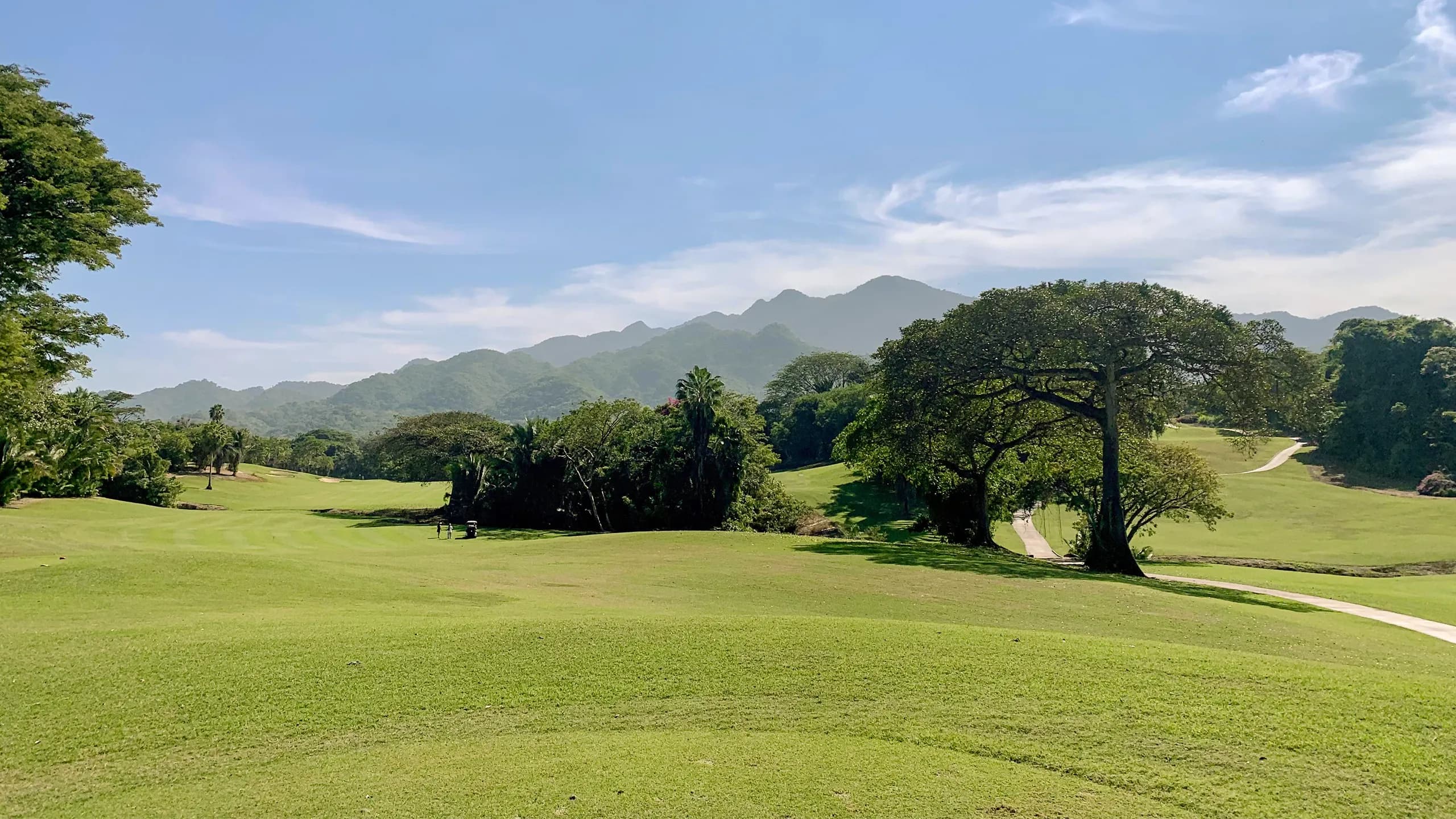
South of Vidanta, Vista Vallarta Club de Golf provides two contrasting 18-hole courses designed by Jack Nicklaus and Tom Weiskopf.
The Nicklaus Course occupies the higher portion of the property, where broad fairways and elevated positions open views toward Banderas Bay, Marina Vallarta, and the Sierra Madre. The Weiskopf Course feels more enclosed and topographical, moving through jungle, ravines, creeks, and sharper elevation changes. The two courses share a clubhouse environment but ask different questions of the player.
The Nicklaus design often feels expansive and strategic. The Weiskopf routing is more rugged, asking the golfer to respond to terrain that can be difficult to read from a flat yardage alone. Played consecutively, they provide one of the region's clearest demonstrations of how architecture can interpret the same mountain landscape in two distinct ways.
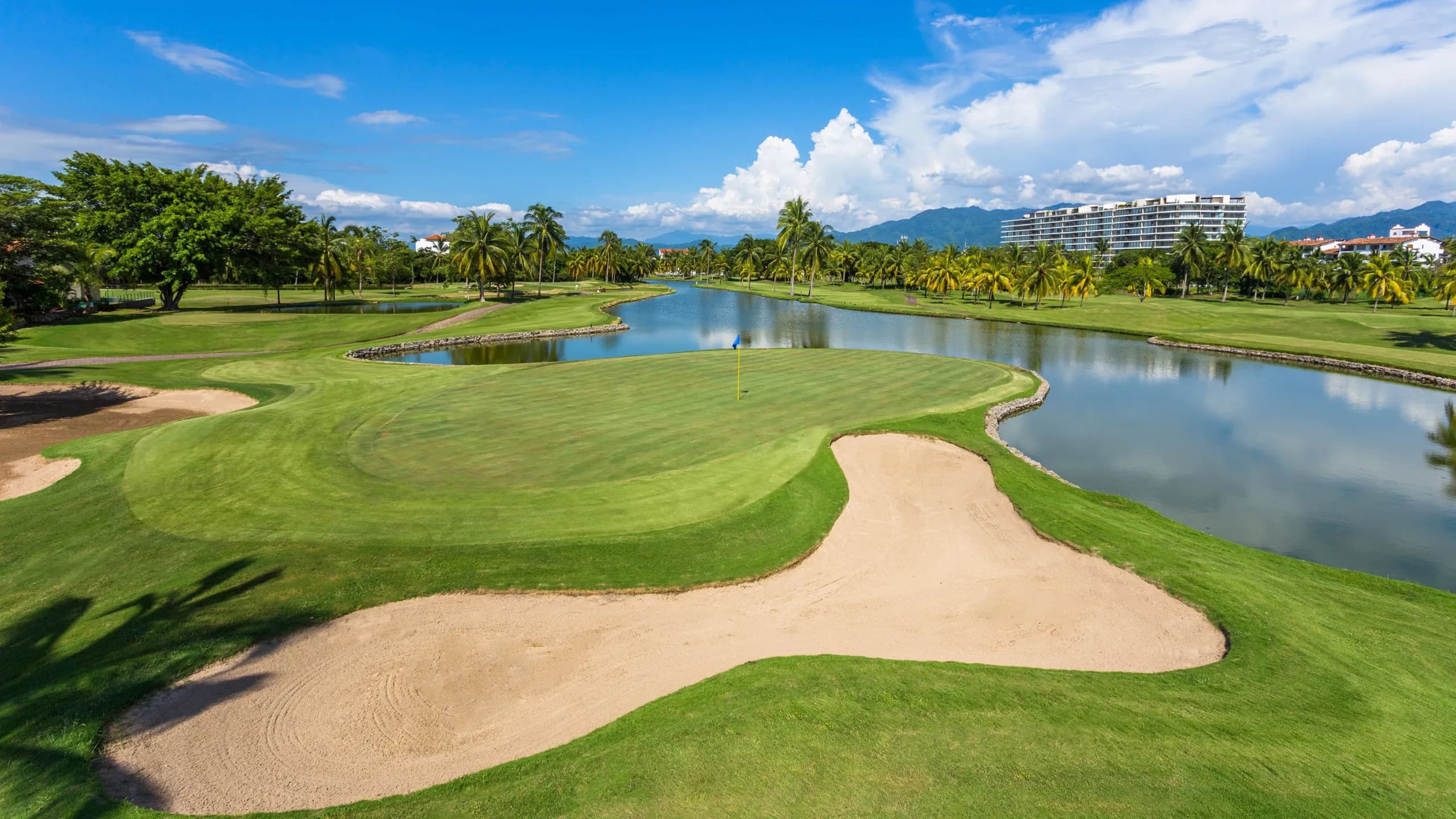
Closer to the city and airport, Marina Vallarta Golf Club offers another register. Its Joe Finger design is more compact and urban, surrounded by the mature fabric of Marina Vallarta. It may not provide the scale of Vidanta or the elevation changes of Vista Vallarta, but its location makes it practical for an arrival day, a shorter stay, or a golfer who prefers to remain close to restaurants and hotels.
Further north, Punta Mita presents the region's most established ocean-golf experience.
The private community contains two Jack Nicklaus Signature courses. Pacifico includes an optional par-three island green known as the Tail of the Whale, reached across open Pacific water when conditions permit. Bahia, opened later, provides a complementary test built around undulating fairways, deep greenside bunkering, and five holes along the ocean.
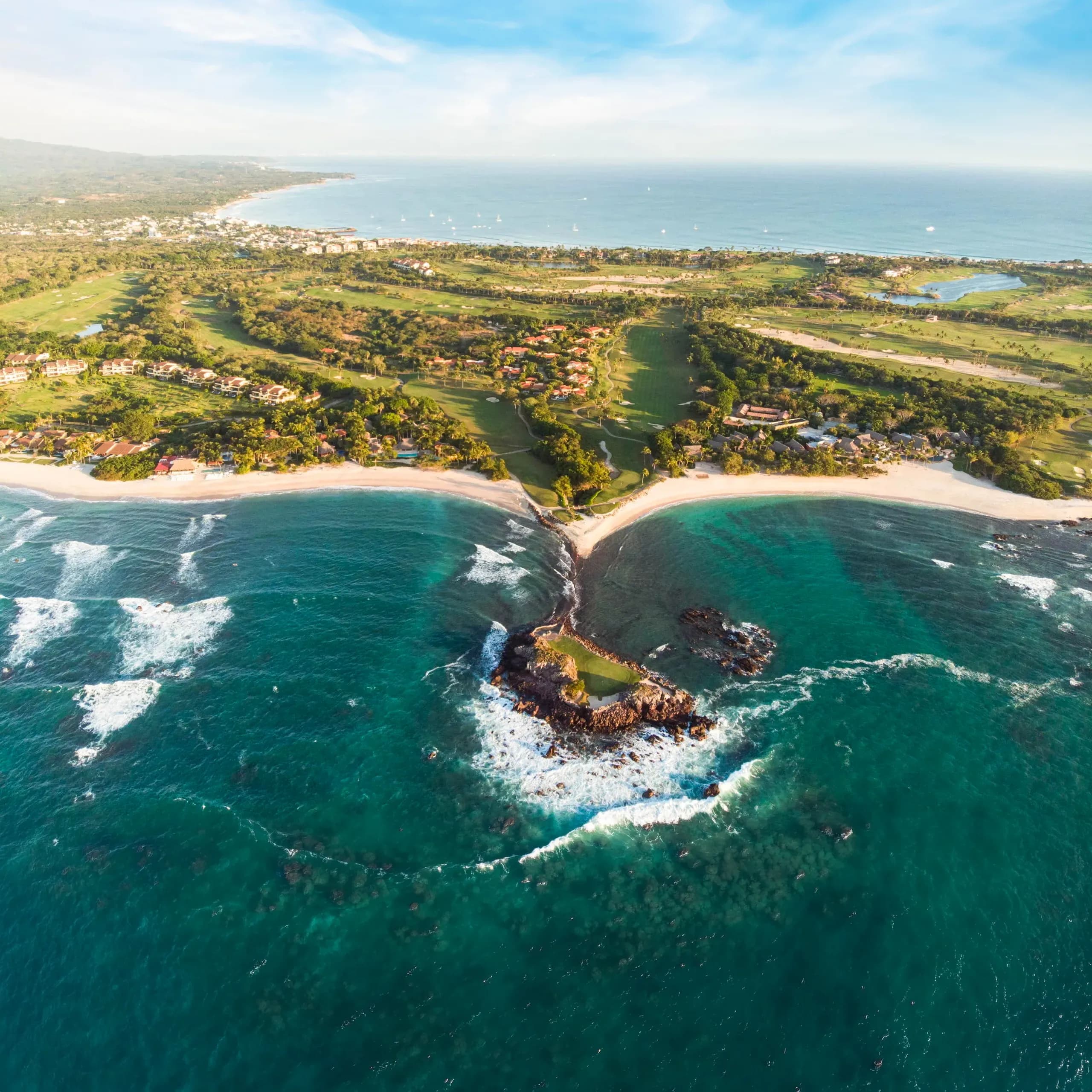
The setting is exceptional, but access should be understood before building an itinerary. Punta Mita Golf Club is primarily available to club members, residents, their guests, and guests staying at participating Punta Mita resorts. It is not simply another public tee time to add at the last moment. Accommodation and golf arrangements often need to be considered together.
Just outside that private environment, Higuera Golf Club offers a different Greg Norman interpretation. Its 18 holes move between links-influenced terrain, jungle corridors, and two signature holes near the Pacific. The course measures 7,022 yards from the back tees and uses wind, elevation, narrow targets, and extensive bunkering to produce a more exposed, elemental round than Vidanta.
Further north again, Mandarina Golf Club rejects the assumption that every significant golf experience must be a full-length course. Norman's design consists of nine par-three holes and an additional challenge hole, set against the Sierra de Vallejo and the grounds of Mandarina's equestrian and polo club. It is better understood as a precision course and a social golf experience than as a substitute for an 18-hole championship round.
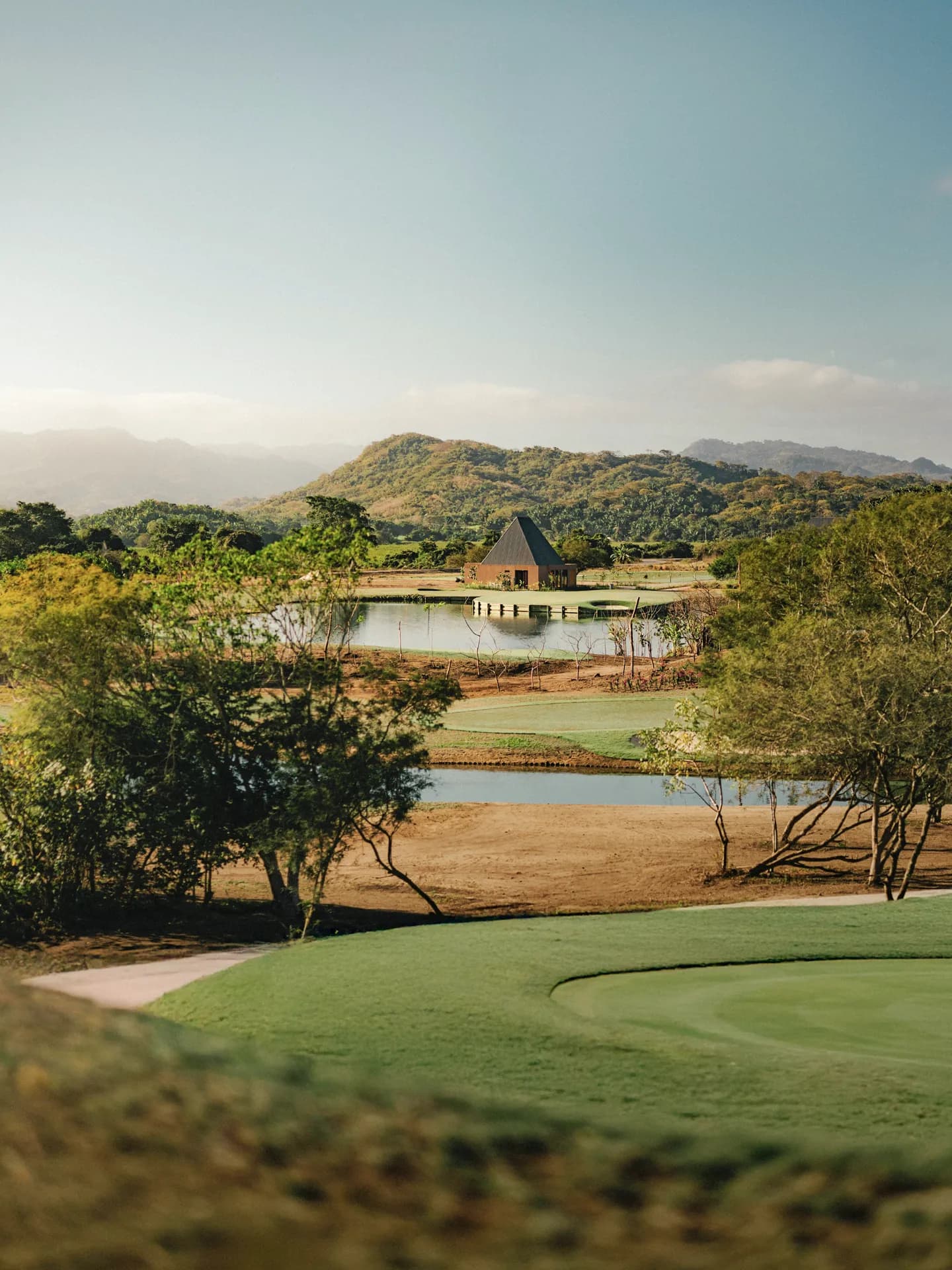
That distinction is part of its appeal. After several demanding rounds, a short course can restore the improvisational side of the game: one club decision, one controlled swing, one green at a time.
Designing the Regional Golf Trip
The variety makes itinerary-building easy in theory, although the geography requires some discipline.
The coast is connected, but it is not compact. Puerto Vallarta, Nuevo Nayarit, Vista Vallarta, Punta Mita, Higuera, and Mandarina occupy different parts of a corridor that becomes more dispersed as it moves north. Traffic and resort access procedures can turn an apparently simple tee-time schedule into a rushed morning.
A thoughtful trip therefore works best in geographic chapters.
Vidanta can anchor the opening days because of its proximity to Puerto Vallarta International Airport and the concentration of three golf formats within the resort. Vista Vallarta and Marina Vallarta belong naturally to the Puerto Vallarta portion of the trip. Punta Mita, Higuera, and Mandarina make greater sense when paired with accommodations farther north rather than approached repeatedly from the city.
The ideal four- or five-day rota is not necessarily the one that accumulates the greatest number of courses. It is the one that preserves enough time to understand the differences between them.
A morning at Vidanta should not feel interchangeable with a round at Punta Mita. Vista Vallarta's mountain terrain should not become a hurried stop between hotel transfers. Mandarina's short course works precisely because it allows the day to retain space around it.
Luxury, in this context, is not simply access to expensive golf. It is control over the pace of the trip.
The Hours Between Rounds
The wider destination becomes important because even committed golfers spend more time away from the first tee than standing on it.
VidantaWorld Vallarta-Nuevo Nayarit extends across more than 1,000 hectares and combines its golf courses with beachfront, accommodations, spas, restaurants, shopping, entertainment, and Cirque du Soleil's LUDO production. During tournament week, the resort infrastructure allows professional golf to sit inside a broader travel experience rather than operate as an isolated sports venue.
Punta Mita follows a different model. Its two courses are integrated into a private residential and resort community that includes Four Seasons Resort Punta Mita and The St. Regis Punta Mita Resort. Golf, beach clubs, dining, wellness, and accommodation are managed as parts of the same controlled environment, which is one reason the destination is particularly effective for couples or groups in which not everyone intends to play every round.
At Mandarina, the experience shifts again. One&Only's treehouses, cliff villas, private residences, rainforest setting, beach, and short course create a quieter interpretation of the golf resort - less centered on accumulating rounds and more interested in integrating golf with architecture, privacy, and the surrounding terrain.
Puerto Vallarta contributes something the self-contained resorts cannot: the texture of a functioning city.
Its dining culture moves between neighborhood taquerias, contemporary Mexican kitchens, seafood restaurants, tasting menus, and long-established local institutions. The 2026 MICHELIN Guide's recognition of addresses including ICU and Pancho's Takos illustrates the range more effectively than any single definition of fine dining could. One is not a replacement for the other. Together, they reflect a city in which an evening meal can be as formal or as direct as the day requires.
This matters because the most convincing golf destinations do not require every hour to remain inside the golf economy. They allow the game to establish the structure of the trip without limiting its meaning.
A round may begin the day. It does not need to explain the entire destination.
What the Tournament Ultimately Confirms
The VidantaWorld Mexico Open gives Riviera Nayarit and Puerto Vallarta a recurring moment of international attention.
It places professional players on a Greg Norman course beside the Ameca River. It brings the language of FedExCup points, tournament strategy, broadcast coverage, and competitive pressure into a landscape more commonly associated with coastal travel. It gives golfers at home a recognizable point from which to begin imagining their own round.
But tournaments can confer visibility more easily than they can create depth.
The depth was already here: in the difference between Norman's work at Vidanta and Higuera; in the contrast between Nicklaus and Weiskopf at Vista Vallarta; in the ocean-facing architecture of Pacifico and Bahia; in the ability to play a short course beneath lights or fit a city course into an arrival day.
It is also present in the practical realities - the seasonal humidity, the distances between courses, the restricted access at certain clubs, and the need to decide whether a trip should prioritize competitive golf, resort privacy, urban dining, or some deliberate combination of all three.
Those distinctions are not weaknesses in the destination. They are what make it legible.
The 2026 VidantaWorld Mexico Open will arrive, produce a champion, and eventually disappear from the schedule into tournament history. The course will remain. So will the river, the mountains, the evening light, and the wider network of places where golf has become part of the coast's contemporary identity.
The event provides the occasion to look.
The region provides the reason to return.
Filed under